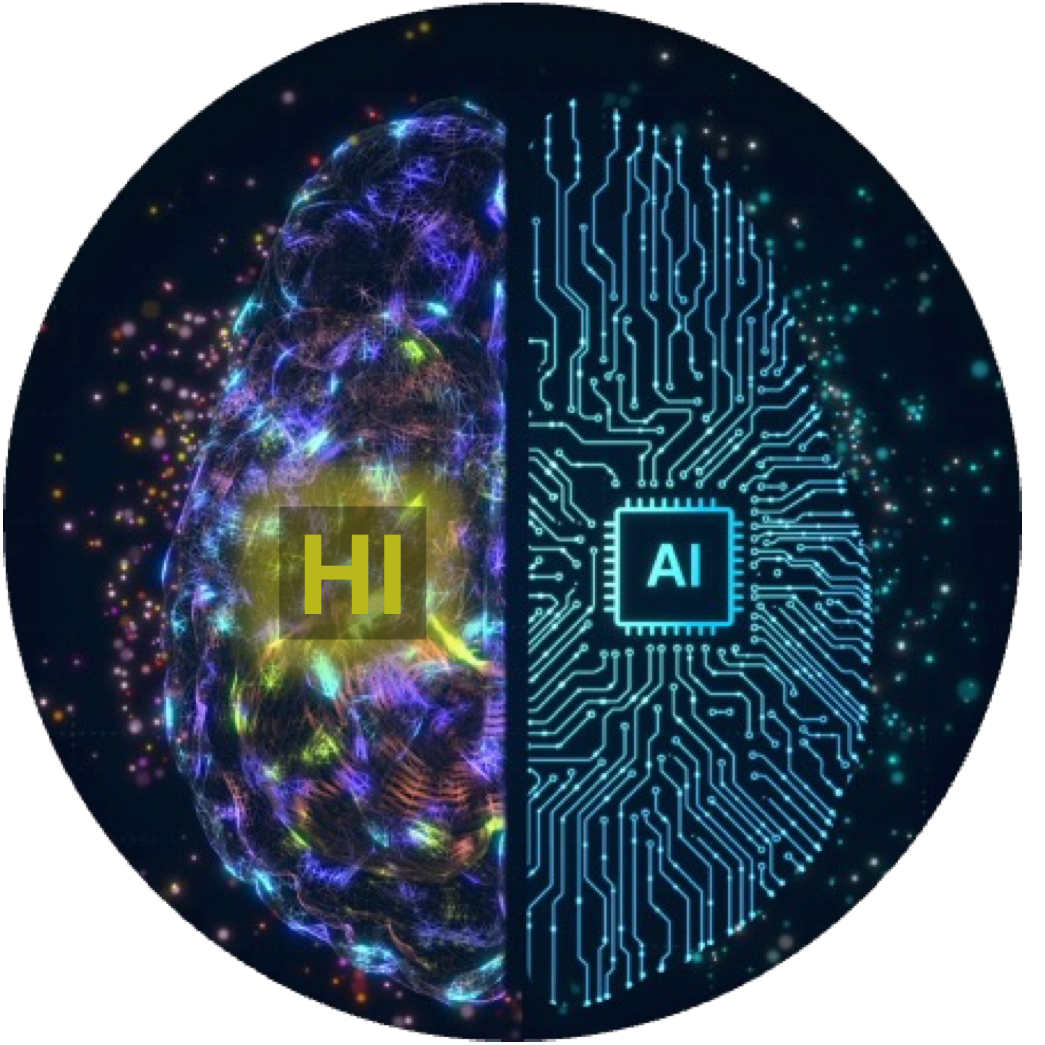
Human Intelligence + AI

The Cognitive Frontier

A New Theory of Human-AI Co-Evolution

"Catalyzing a continuous cycle of co-evolution between human and artificial intelligence."

Contents

Executive Summary

AI scaling has hit diminishing returns. The bottleneck is not computational—it is cognitive. We propose a bidirectional co-evolution cycle that advances both human and artificial intelligence by focusing on complementary intelligence (c)—the cognitive dimensions where humans maintain a qualitative edge.
01
Chapter One

The Problem:
Why AI Has
Hit a Wall

The era of simple scaling is over. Leading AI researchers are recognizing that the next breakthrough won't come from bigger models—it will come from understanding the human mind.

"The 2010s were the age of scaling. Now we're back in the age of wonder and discovery."

— Ilya Sutskever, OpenAI Co-founder

The Scaling Crisis

For the past decade, AI progress followed a simple formula: more data, more compute, better results. This era delivered transformative capabilities—from language models to image generation. But the curve is bending.

The fundamental issue isn't computational. It's that current AI optimizes within a narrow framework based on Spearman's general intelligence (g) from 1904—a concept that captures only 40-50% of human cognitive variance.

Exhibit 1
Four Converging Crises Demanding a New Approach

Current Limitations

  • Scaling Crisis: Diminishing returns on compute
  • Moravec's Paradox: Easy human tasks remain hard
  • Data Limitation: Missing "process data"
  • Adoption Crisis: 75% fear job displacement

Opportunity Space

  • Cognitive Grounding: Brain architecture insight
  • Complementarity: Human-AI teams excel
  • Process Data: Capture reasoning traces
  • Upskilling: Workers embrace upgrades
Source: Filiciti Labs analysis; EY Workforce Survey 2024

The Data Everyone Is Missing

Most AI training data is "result-oriented"—final outputs, correct answers. What's absent is Process Data: how thought forms, reasoning traces, decision branches. This is cognitive "dark matter."

Key Insight

The bottleneck isn't compute. We're optimizing AI for a narrow slice of intelligence while ignoring territories where humans maintain qualitative advantages.

Industry Leaders Sound the Alarm

We're not alone in recognizing these limitations. The most influential voices in AI are calling for fundamental change:

LeaderPosition
Ilya Sutskever
OpenAI Co-founder
"The 2010s were the age of scaling. Now we're back in the age of wonder and discovery."
Yoshua Bengio
Turing Award Winner
Advocates for "System 2" deep learning—moving beyond pattern matching to reasoning.
Gary Marcus
NYU, AI Critic
"Deep learning is hitting a wall" in achieving robust, generalizable intelligence.
Demis Hassabis
DeepMind CEO
Emphasizes grounding AI in neuroscience to achieve general intelligence.
Erik Brynjolfsson
MIT/Stanford
"Human-AI complementarity outperforms either alone" in economic productivity.

"Weak human + machine + better process beats strong computer alone."

— Garry Kasparov, on "Centaur" chess teams after Deep Blue

This convergence of expert opinion points to a clear conclusion: the next frontier of AI isn't about bigger models. It's about understanding what makes human cognition irreplaceable.

02
Chapter Two

From g to c:
A New Theory
of Intelligence

For over a century, intelligence research focused on Spearman's g—a general factor. But g is incomplete, not wrong. We operationalize the missing dimensions as complementary intelligence (c).

Introducing Complementary Intelligence (c)

Spearman's general intelligence factor (g), proposed in 1904, shaped a century of cognitive science. It captures correlation across cognitive tests—people good at one mental task tend to be good at others.

The problem: g explains only 40-50% of cognitive variance. The remaining 50-60% represents dimensions where humans maintain qualitative advantages over AI.

Exhibit 2
The Intelligence Gap: What g Misses
Cognitive Variance
g — 45%
c — 55%
General Intelligence
AI excels here
Complementary Intelligence
Human edge — our focus

c complements g to account for 100% of cognitive variance

Source: Meta-analysis of cognitive variance studies; Filiciti Labs

What Makes c Different

We operationalize complementary intelligence (c) as cognitive primitives that are:

Exhibit 3
Under-Utilized Cognitive Primitives
Meta-cognitive Monitoring

Knowing what you don't know. Requires genuine uncertainty, not probability distributions.

Epistemological Intelligence

How we know what we know. No AI has a grounded world model.

System Thinking

Complex interdependencies. AI trained on isolated examples, not systems.

Dual-Process Integration

Balancing intuition and analysis. AI only has System 2.

Contextual Judgment

Decision-making under ambiguity. AI needs explicit rules.

Collaborative Sense-Making

Group cognition exceeding individual reasoning.

These represent capabilities we're mapping. c is a research program, not a fixed list.
The Key Shift

We move from g (general intelligence) to c (complementary intelligence)—focusing on dimensions where humans maintain a qualitative edge and where human-AI collaboration creates the most value.

Current AI excels at pattern recognition and statistical inference—capabilities well-captured by g. But they lack embodied experience, social intuition, and genuine understanding that characterize human cognition.

03
Chapter Three

The Co-Evolution
Model

The dominant narrative frames AI as a threat to human relevance. We reject this zero-sum framing. Instead, we propose a positive-sum model where AI advancement drives human development—and vice versa.

From Competition to Co-Evolution

The prevailing discourse follows a competitive frame: as machines get smarter, humans become less relevant. This zero-sum thinking misreads history and misses the biggest opportunity of our time.

Exhibit 4
Competition Model vs. Co-Evolution Model

Competition Model

  • AI smarter → humans obsolete
  • Zero-sum: AI wins, humans lose
  • Humans as bottleneck to eliminate
  • Replace human judgment

Co-Evolution Model

  • AI smarter → humans level up → cycle
  • Positive-sum: Both advance
  • Humans as data source + frontier
  • Augment judgment ("Centaurs")

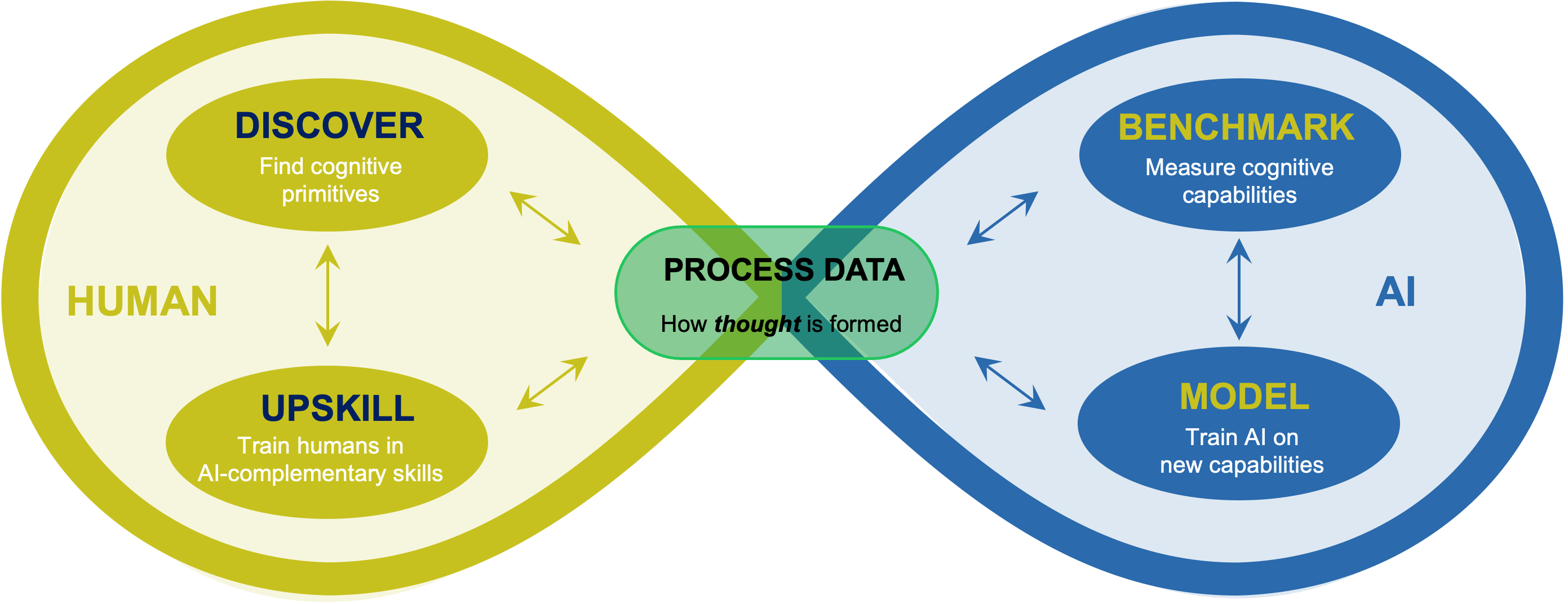
The Infinite Loop

Exhibit 5
The Co-Evolution Engine: A Continuous Cycle
Human-AI Co-Evolution Cycle

As AI masters Level N, we discover the next frontier and upskill humans to Level N+1.

Process Data: The Missing Link

Most AI training data captures results—final outputs. What's missing is Process Data: how thought forms, reasoning traces, decision branches, uncertainty calibration.

Our human training programs generate this Process Data at scale. This dataset doesn't exist anywhere else—and it's key to training AI on cognitive dimensions that matter.

75%
of employees fear AI will eliminate their jobs
80%+
would embrace AI if fear barriers addressed
The Centaur Principle

After Deep Blue, Kasparov discovered that weak human + machine + better process beats strong computer alone. We don't replace humans. We create Centaurs—human-AI teams that outperform either component.

People resist tools that replace them—but embrace tools that upgrade them. When employees see AI as amplifying their capabilities rather than threatening livelihoods, adoption accelerates.

The co-evolution model isn't wishful thinking. It's how complex systems naturally evolve. Predators and prey, immune systems and pathogens—mutual pressure creates mutual advancement.

04
Chapter Four

Research
Foundation &
Methodology

Our approach is grounded in peer-reviewed neuroscience, not speculation. The Behavioral Wind Tunnel methodology provides the scientific foundation for measuring and developing complementary intelligence.

Behavioral Wind Tunnels

Like aerospace wind tunnels that test aircraft under controlled conditions, Behavioral Wind Tunnels create controlled, ecologically valid environments for mapping intelligence in real tasks.

Peer-Reviewed Validation

Our methodology has been published in the Journal of Neuroscience, 2025. This isn't theoretical—it's validated science.
jneurosci.org/content/45/45/e1705252025

Trait-State Decomposition

Our methodology separates stable individual differences (traits) from context-dependent variations (states). This allows us to:

Exhibit 6
The Research-to-Product Pipeline
Neuroscience
Research
Behavioral
Wind Tunnels
Cognitive
Measurement
Training
Programs
AI
Benchmarks
Filiciti Labs vertically integrated methodology

Addressing Scientific Critiques

We believe transparency builds trust. Here are hard questions we've faced—and our responses:

ChallengeOur Response
"Spearman's g still works"g is incomplete, not wrong. It explains 40-50% of variance. We operationalize the other 50-60% as c.
"'New intelligence' = pseudoscience"We identify "under-utilized cognitive primitives"—measurable, neuroscience-grounded with peer-reviewed validation.
"AI learns faster than humans"Speed isn't the point. We focus on qualitative difference. Kasparov's Law: the combination outperforms either alone.
"Generic soft skills training"Precision neuroscience + trait-state decomposition. Measurable cognitive development with neural correlates.

"We focus on architecture—understanding the source code of the brain. We define ground truth before tech companies know what to look for."

— Filiciti Labs research philosophy
05
Chapter Five

Business Model
& Competitive
Advantage

Two markets, one flywheel. Enterprise workforce programs generate the Process Data that makes our AI benchmarks uniquely valuable—creating a self-reinforcing competitive moat.

"Talent can be hired. Data cannot be backfilled."

Two Markets, One Flywheel

Our business model serves two distinct markets that reinforce each other, creating a flywheel effect that compounds over time.

Exhibit 7
Dual Market Strategy

B2B Enterprise

"Cognitive Edge" Workforce Programs

  • Create "Centaur" teams with AI
  • Measured decision quality improvements
  • Annual SaaS + implementation fees

B2B AI Labs

"Beyond Pattern Matching" Evaluation

  • Benchmarks for complementary intelligence
  • High-fidelity Process Data for training
  • API access + data licensing
Exhibit 8
The Revenue Flywheel: Process → Revenue
Upskill Humans
Enterprise SaaS Revenue
Generate Process Data
Data Asset Value
Improve Benchmarks
API Licensing Revenue
Attract AI Labs
Data Licensing Deals
Fund Research
Reinvestment ↺

Each process step generates revenue that feeds the next cycle

Competitive Moat

The Data Moat

"Talent can be hired. Data cannot be backfilled." Our longitudinal Process Data compounds over time, creating structural first-mover advantage that competitors cannot replicate.

Our defensibility comes from four interlocking advantages:

  1. Source Code Advantage: We understand brain architecture, not just AI engineering. We define ground truth before tech companies know what to look for.
  2. Proprietary Longitudinal Process Data: How thought forms, tracked over time. Generated through training programs; doesn't exist elsewhere.
  3. Unique Methodology: Behavioral Wind Tunnels + trait-state decomposition + AI benchmarking—a vertically integrated pipeline.
  4. Continuous Discovery: c is a moving target. We discover new primitives faster than competitors can copy.

Addressing Business Model Critiques

ChallengeOur Response
"EdTech AND AI Research?"Human training is our data labeling pipeline, not a separate product. Training generates the Process Data that makes benchmarks valuable.
"Big labs can copy you"Talent can be hired; Process Data cannot be backfilled. Our longitudinal data compounds. First-mover advantage is structural.

The Long View

The question isn't whether AI will transform work—it's whether that transformation will be zero-sum or positive-sum. We're building for a future where AI advancement drives human development, human development drives AI advancement, and the cycle continues.

This isn't utopian speculation. It's how complex systems evolve. Predators and prey, immune systems and pathogens. Mutual pressure creates mutual advancement.

Our Bet

The organizations and societies that master human-AI complementarity will outcompete those that pursue replacement. We're building the infrastructure for that future.

What We Believe

  • AI advancement should drive human development
  • Human development should drive AI advancement
  • The cycle can continue indefinitely
  • Complementarity beats replacement

What We're Building

  • Neuroscience-grounded cognitive measurement
  • Enterprise training that generates Process Data
  • AI benchmarks for complementary intelligence
  • The co-evolution engine

Ready to Partner?

Whether you're building AI or building with AI, we're ready to help you navigate the cognitive frontier.

Email: info@filiciti.com  |  Web: labs.filiciti.com

"Catalyzing a continuous cycle of co-evolution between human and artificial intelligence."

labs.filiciti.com

© 2025 Filiciti Labs. All rights reserved.